

 Eng
Eng 
 Español
 عربى
عربى

Lithium Battery Fan Provides Portable Cooling Anywhere
 2026.05.29
 Industry News
The lithium battery fan has gained attention as a convenient cooling solution for spaces without electrical outlets. Unlike corded fans that require nearby wall sockets, a lithium battery fan operates on rechargeable power packs that provide several hours of airflow per charge. Campers, construction workers, and event staff have adopted the lithium battery fan for use in tents, job sites, and outdoor gatherings. The combination of portability and rechargeable operation explains the growing market for lithium battery fan products. Manufacturers continue to introduce new sizes and airflow ratings to serve different user needs.
Battery capacity represents a key specification for any lithium battery fan. A lithium battery fan with a larger amp-hour rating runs longer between charges but adds weight to the unit. Typical lithium battery fan models include battery packs ranging from two to six amp-hours depending on intended runtime. The battery chemistry used in a lithium battery fan affects both energy density and charge cycle life. A lithium battery fan designed for professional job site use may include swappable battery packs for continuous operation. Charging time for a lithium battery fan battery usually ranges from two to four hours with standard chargers.
Airflow performance varies across different lithium battery fan designs. A small personal lithium battery fan produces airflow sufficient for one person at close range. A larger lithium battery fan intended for shop or tent use moves air across several meters and can serve multiple people. The blade diameter of a lithium battery fan influences both air volume and noise output. A lithium battery fan with adjustable speed settings allows users to balance airflow against runtime requirements. The oscillation feature on some lithium battery fan models distributes air across a wider area without manual repositioning.
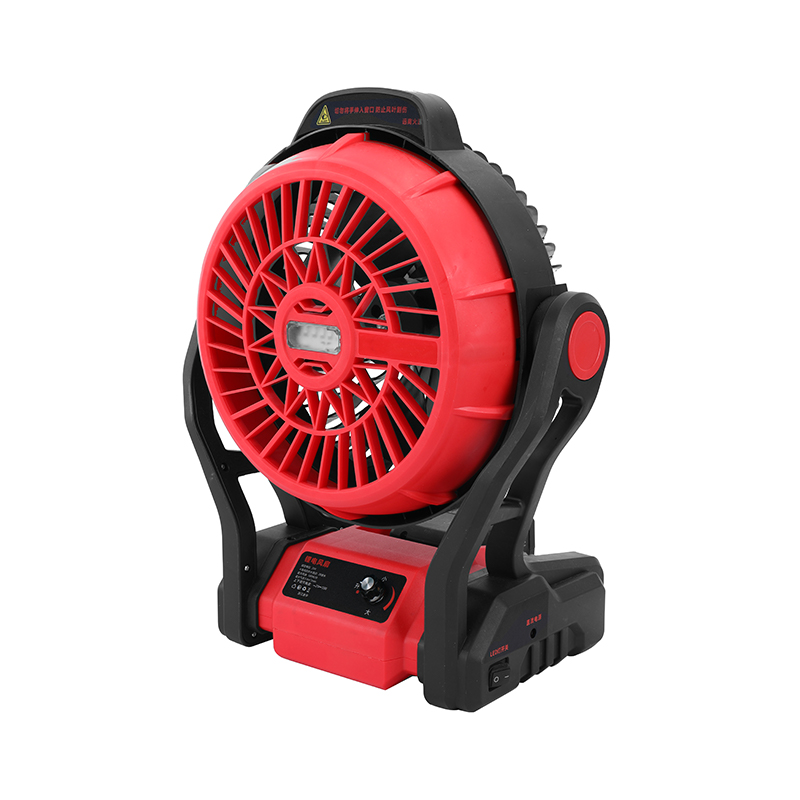
Durability considerations for a lithium battery fan relate to its intended use environment. A lithium battery fan for job site use often includes rubberized corners and impact-resistant housing. Weather resistance on a lithium battery fan allows operation during light rain or dusty conditions without damage. The grille spacing on a lithium battery fan prevents finger contact with spinning blades while maintaining adequate airflow. A lithium battery fan used in workshops may incorporate a magnetic base for attachment to metal surfaces. Hanging hooks on some lithium battery fan units allow mounting from tent poles or scaffolding structures.
Portability features affect how users carry and position a lithium battery fan. A lightweight lithium battery fan weighing under one kilogram fits easily into backpacks or tool bags. The handle design on a lithium battery fan should allow one-handed carrying without awkward grip positions. A pivoting head on a lithium battery fan directs airflow upward or downward while the base remains stationary. A lithium battery fan with a flat bottom sits stably on tables, floors, or tailgates. Storage pockets for small lithium battery fan units keep the device accessible in vehicle door panels or seatback organizers.
The lithium battery fan will likely continue gaining users across camping, construction, and emergency preparedness markets. Improvements in battery energy density may extend run times without increasing unit weight. For anyone needing airflow where electrical outlets are absent, the lithium battery fan offers a practical solution.




 Home
Home +86-135 0659 5098
 No. 167, Lingshi Road, Chengxi New District, Yongkang City, Jinhua City, Zhejiang Province, China.
Copyright ©YONGKANG XINDAI TECHNOLOGY CO.,LTD. All rights reserved.
China Garden Tool
